The Most Important Key to Happiness: Living with Your Own Inner Compass
 noji_nojio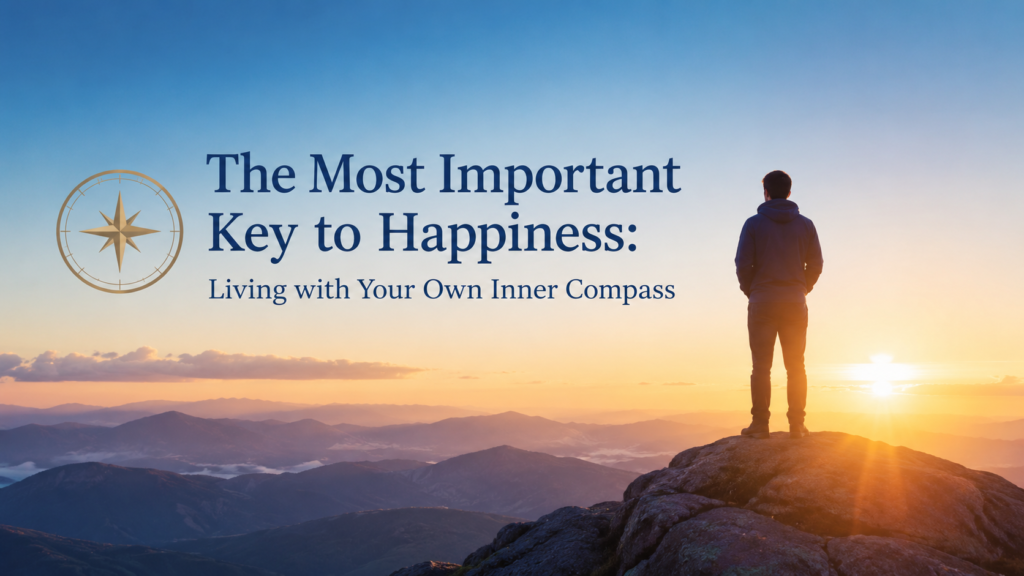
※ 本ページはプロモーションが含まれています。※ 他のトラブル解決も“ノジオ”で検索
Everyone wants to be happy.
No matter where we live or what we do, the desire for happiness is one of the few things all human beings have in common.
Yet we often see a curious contradiction.
Some people have a stable income, a loving family, and good health, but they constantly complain about life.
Others face illness, financial hardship, or personal struggles, yet they live with remarkable peace and gratitude.
Why does this happen?
After many years of observing people and society, I have come to believe that one of the biggest differences lies in whether a person has an inner compass—a personal set of values that guides their decisions and gives direction to their life.
Without such a compass, people are easily swayed by the opinions of others and by society's ever-changing standards. Their happiness becomes unstable because it depends on external approval.
In this article, we'll explore why developing your own inner compass is the foundation of lasting happiness and how you can begin cultivating it.
- 1. The Trap of Living by Comparison
- 2. Without an Inner Compass, Your Opinions Constantly Change
- 3. You Need a Standard to Make Good Decisions
- 4. Your Inner Compass Builds Trust
- 5. The First Step Is Learning to Observe Yourself
- 6. Think Beyond the Present Moment
- 7. Create Distance from Constant Comparison
- 8. Learn Timeless Wisdom
- 9. Conclusion
The Trap of Living by Comparison
From childhood, we are taught to compare ourselves with others.
Grades.
Test scores.
Income.
Job titles.
Social status.
Competition itself isn't necessarily bad. It often motivates people to improve and has contributed to human progress.
The problem begins when comparison becomes the primary measure of our self-worth.
"My salary is lower than theirs."
"My friends seem happier."
"Everyone on social media has a better life."
When our attention is always focused outward, happiness becomes dependent on other people's circumstances.
And there will always be someone who appears richer, smarter, more successful, or more attractive.
If your happiness depends on being better than others, the race never ends.
True happiness is not a ranking.
It is a state of mind.
The more we compare ourselves with others, the less able we become to appreciate the life we already have.
Without an Inner Compass, Your Opinions Constantly Change
Some people are remarkably influenced by those around them.
They strongly defend one opinion today, only to reject it tomorrow because the people around them have changed their minds.
They say one thing to one group and something completely different to another.
Often, this happens unconsciously.
Instead of thinking independently, they simply adapt to whatever environment they happen to be in.
Of course, changing your opinion after learning new information is a sign of growth.
The problem is not changing your mind.
The problem is never having a clear standard of your own.
When we continually adjust ourselves to fit others' expectations, we eventually lose sight of what we truly believe.
People naturally trust those who demonstrate consistency.
Someone whose words and actions remain aligned over time creates a sense of reliability.
On the other hand, someone whose values constantly shift may leave others wondering who they really are.
Deep friendships and lasting relationships are often built on consistency of character.
You Need a Standard to Make Good Decisions
Human beings understand the world through comparison.
We recognize brightness because darkness exists.
We recognize warmth because we have experienced cold.
The same principle applies to everyday life.
Whether a product is expensive or inexpensive depends on our knowledge of its typical price.
Whether food tastes excellent or average depends on our past experiences.
Life works the same way.
Without your own standards, it becomes difficult to answer important questions:
- Is this career right for me?
- Is this the kind of life I truly want?
- Will I regret this decision later?
Without an internal standard, people naturally borrow society's standards instead.
But living according to someone else's values rarely brings genuine fulfillment.
Your Inner Compass Builds Trust
Success in life is not determined only by what you can do.
It is also influenced by who you are.
People who consistently act according to their values create trust.
Because they are dependable, they are given greater responsibility.
They build stronger relationships.
Their reputation grows over time.
Trust cannot be created overnight.
It is built through countless small actions repeated consistently over many years.
When people's attitudes change depending on the situation, others hesitate to rely on them.
Trust is one of life's greatest assets.
And people with a strong inner compass are far more likely to earn it.
As a result, their personal relationships, careers, and even financial opportunities often become stronger.
The First Step Is Learning to Observe Yourself
So how can we develop an inner compass?
The first step is self-observation.
Ask yourself questions like these:
- What made me angry today?
- Why did I react so strongly?
- What brought me genuine joy?
- During which moments did I feel most fulfilled?
These questions help us understand ourselves more objectively.
Psychologists call this ability metacognition—the capacity to observe your own thoughts from a higher perspective.
As your self-awareness grows, your personal values gradually become clearer.
Keeping a journal or quietly reflecting on your day each evening can be powerful ways to strengthen your inner compass.
Think Beyond the Present Moment
Happy people often share one important habit.
They don't judge life based only on immediate results.
A failure today may feel painful.
But looking back ten years later, that same experience may prove to have been one of the most valuable turning points in your life.
People who make decisions based solely on today's emotions are easily shaken by temporary setbacks.
Those with a long-term perspective evaluate their choices within the larger story of their lives.
Life is more like a marathon than a sprint.
You don't need to judge your entire life based on today's success or failure.
A long-term perspective provides stability for your inner compass.
Create Distance from Constant Comparison
Modern life encourages endless comparison.
Social media constantly presents images of successful careers, luxurious vacations, expensive cars, beautiful homes, and seemingly perfect families.
But these images represent only carefully selected moments.
They are not the whole story.
If you constantly surround yourself with comparison, it becomes difficult to hear your own voice.
Sometimes, the healthiest choice is to step away.
Read a book.
Take a walk in nature.
Put away your smartphone.
Spend time listening to your own thoughts instead of everyone else's.
Quiet moments often strengthen the inner compass that constant noise weakens.
Learn Timeless Wisdom
Finally, it helps to study ideas that have stood the test of time.
For thousands of years, human beings have asked the same question:
How can we live a happy life?
Philosophy, psychology, Buddhism, and ethics all contain insights that remain relevant across generations.
Trends change every few years.
Technology evolves rapidly.
But human nature changes very slowly.
Instead of chasing every new trend, spending time with timeless wisdom can help us build a stable foundation for life.
Conclusion
Life will never unfold exactly as we expect.
Public opinion changes.
Social values change.
The world itself changes.
If our happiness depends entirely on those changing circumstances, lasting peace becomes impossible.
That is why we need something stable within ourselves.
Having an inner compass does not mean becoming stubborn or refusing new ideas.
It means remaining open to learning while continuing to ask one essential question:
"What do I truly believe?"
Happiness is not simply about gaining approval from others.
It is about living a life that you can genuinely accept as your own.
When you build a strong inner compass, happiness no longer depends on the world around you.
It begins to grow quietly from within.